
For years, the modern kitchen was defined by a very specific look: bright white countertops, white cabinetry, glossy finishes, and clean minimalist lines. The goal was simplicity. The result was often beautiful—but sometimes a little too uniform.
That design language is beginning to change.
Across Harrisburg and Central Pennsylvania, homeowners planning kitchen renovations are showing increasing interest in spaces that feel warmer, more natural, and more connected to the character of the home. Instead of building an entirely white kitchen, many are combining natural wood cabinetry, soft neutral colors, warm metal finishes, and richly patterned stone.
One of the most distinctive looks emerging from this shift is the use of warm-toned natural granite—featuring shades of taupe, cream, beige, honey, caramel, and subtle cinnamon—combined with a dramatic waterfall edge on the kitchen island.
The result is a kitchen that can feel contemporary without becoming cold, luxurious without feeling overly formal, and visually striking without depending on a short-lived design trend.
Harrisburg Kitchens Are Moving Toward Warmer Materials
For much of the last decade, white dominated kitchen design. White quartz countertops and bright cabinets became the default choice for homeowners looking to create a clean, modern interior.
Today, however, many homeowners are looking for something with more depth.
The kitchen is no longer viewed simply as a functional room hidden away from the rest of the house. It has become one of the central gathering spaces of the home. Families cook, eat, work, entertain, and spend significant amounts of time there.
That change is influencing design choices.
Instead of creating a space that looks perfectly uniform, homeowners are increasingly interested in materials that introduce texture, warmth, and individuality. Natural oak, walnut, and other wood finishes are appearing alongside softer shades of beige, taupe, and cream. Brushed brass, champagne bronze, and darker metal finishes are replacing the highly polished look that dominated previous years.
Natural stone fits naturally into this movement.
A granite slab with warm mineral tones and organic movement introduces something that manufactured, perfectly uniform surfaces cannot easily replicate: individuality.
Every slab is different. The veining, mineral composition, movement, and color variation create a surface with its own visual identity.
For Harrisburg homeowners renovating older homes, updating suburban kitchens, or building new spaces with a more custom appearance, that natural character can become an important part of the overall design.
The Waterfall Island: More Than Just a Countertop
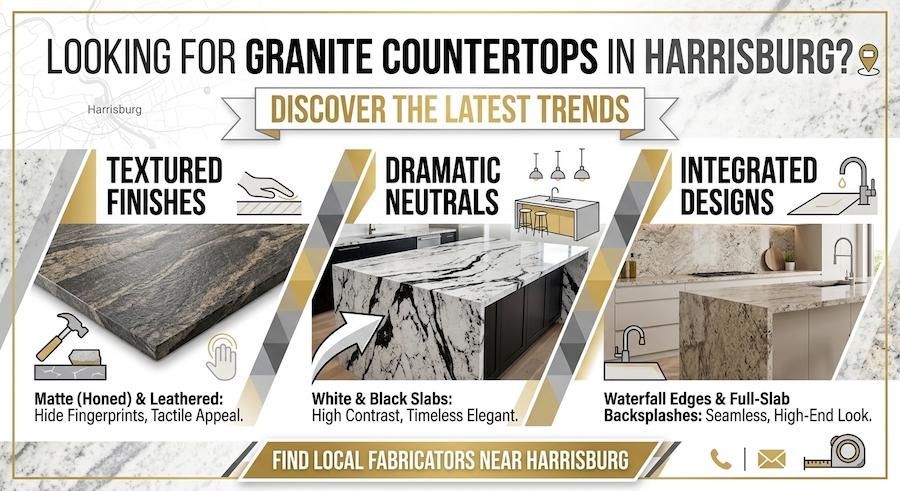
One of the most dramatic ways to use granite in a modern kitchen is through a waterfall edge.
Instead of stopping at the edge of the countertop, the stone continues vertically down the side of the island toward the floor. This creates a continuous visual surface that makes the island feel less like a cabinet with a countertop and more like an architectural element within the room.
The effect becomes particularly impressive when the natural movement of the granite is carefully matched during fabrication.
Veins and patterns can be aligned so that the visual flow continues from the horizontal countertop onto the vertical stone panel. When executed properly, the island becomes a centerpiece that can be appreciated from several angles.
In an open-concept kitchen, this matters even more.
The island is often one of the first things people see when entering the space. A waterfall granite design allows the stone itself to become part of the architecture of the room.
Warm taupe, caramel, cream, and honey-toned granite can give this design a softer appearance than the dramatic black-and-white contrasts often associated with contemporary kitchens.
The result can feel modern while still maintaining a sense of warmth.
Why Warm-Toned Granite Works So Well
1. It Adds Natural Depth to the Kitchen
A completely monochromatic kitchen can sometimes feel visually flat.
Natural granite introduces variation.
Subtle changes in color, mineral patterns, and movement give the surface depth without requiring additional decoration. A cream or taupe granite, for example, may contain small variations of beige, gold, brown, gray, or even darker mineral accents.
Those details help connect different parts of the kitchen.
Cabinets, flooring, wall colors, and metal fixtures can all draw from tones already present in the stone.
Rather than relying on a single dominant color, the kitchen develops a more layered palette.
2. It Works Naturally With Wood Cabinetry
Wood cabinetry is becoming increasingly important in contemporary kitchen design.
Light oak, natural oak, walnut, medium-toned woods, and even darker stained finishes can work beautifully with warm granite.
The combination creates a material palette based on natural elements rather than sharp contrasts.
Wood provides warmth.
Stone provides movement and visual weight.
Metal fixtures introduce refinement.
Together, these materials can create a kitchen that feels designed rather than simply assembled from matching surfaces.
For many Harrisburg homes—particularly properties that combine traditional architectural elements with modern renovations—this balance can work especially well.
3. Natural Movement Can Be More Forgiving in Everyday Kitchens
Kitchens are active spaces.
Cooking, family meals, entertaining, and daily routines all leave their mark on a room. Extremely uniform, bright surfaces can sometimes make small crumbs, water spots, or minor marks more visually noticeable.
Granite with natural movement can visually soften some of that everyday activity.
Its variation creates a surface that feels less delicate and more integrated into the daily life of the household.
This does not mean maintenance disappears—every natural stone should be properly cared for—but the visual character of a naturally patterned slab can make the kitchen feel more relaxed and lived-in.
4. Warm Granite Complements Today’s Metal Finishes
The popularity of warm metal finishes has also helped drive interest in warmer stone colors.
Brushed brass, champagne bronze, antique bronze, and darker metallic hardware can all work beautifully with taupe, cream, honey, and caramel-toned granite.
A soft cream granite paired with warm brass hardware can create an elegant and refined look.
A deeper caramel or cinnamon-toned slab can work especially well with darker cabinetry and aged bronze fixtures.
The goal is not necessarily to match every color perfectly.
Instead, the most successful kitchens often create harmony between several related tones.
Leathered Granite Brings Even More Character
For homeowners who want something beyond a traditional polished countertop, leathered granite offers another design option.
A leathered finish has a softer sheen and a more textured appearance than highly polished stone. It can emphasize the natural character of the slab and create a more tactile, organic look.
This finish works particularly well in kitchens built around natural materials.
Combined with wood cabinetry and a waterfall island, leathered granite can create a space that feels sophisticated without appearing overly polished or formal.
It can be especially appealing for homeowners who want their kitchen to feel warm, substantial, and connected to natural materials rather than highly manufactured.
A Timeless Alternative to the All-White Kitchen
The white kitchen is not disappearing.
It remains a clean and versatile design choice, and it will continue to work beautifully in many homes.
But homeowners are increasingly looking beyond the idea that modern design must be completely white.
Warm neutral colors, natural wood, textured finishes, and expressive stone surfaces offer another direction.
These materials are not dependent on a single trend.
Natural stone has been used in architecture for generations. Wood continues to develop character over time. Neutral colors can adapt as furniture, lighting, and decorative styles change.
That flexibility is particularly valuable when planning a major kitchen renovation.
A countertop is not something most homeowners want to replace after a few years because a design trend has changed.
Choosing materials with natural depth and long-term visual appeal can help create a kitchen that continues to feel relevant even as smaller design details evolve.
Bringing a Custom Granite Waterfall Island to Your Harrisburg Home
A waterfall island requires more than simply choosing a beautiful slab.
The fabrication process is critical.
Precise cutting, thoughtful seam placement, edge detailing, and careful installation all contribute to the final appearance. When the natural movement of the granite is properly planned and aligned, the transition between the countertop and the vertical waterfall panels can create a seamless and dramatic visual effect.
That is why slab selection should be considered together with the overall design of the kitchen.
The cabinetry, flooring, lighting, backsplash, and hardware should all work with the colors and movement found in the stone.
For homeowners in Harrisburg and the surrounding Central Pennsylvania area, a warm-toned granite countertop can become the foundation of an entirely new kitchen design.
Whether you are renovating an older home, updating a traditional kitchen, or creating a more contemporary space, natural granite offers an opportunity to introduce warmth, movement, and individuality.
And when that stone extends into a custom waterfall island, the result can transform the kitchen from a collection of cabinets and appliances into a more architectural and memorable living space.
A carefully selected granite slab does more than provide a work surface.
It can define the entire room.